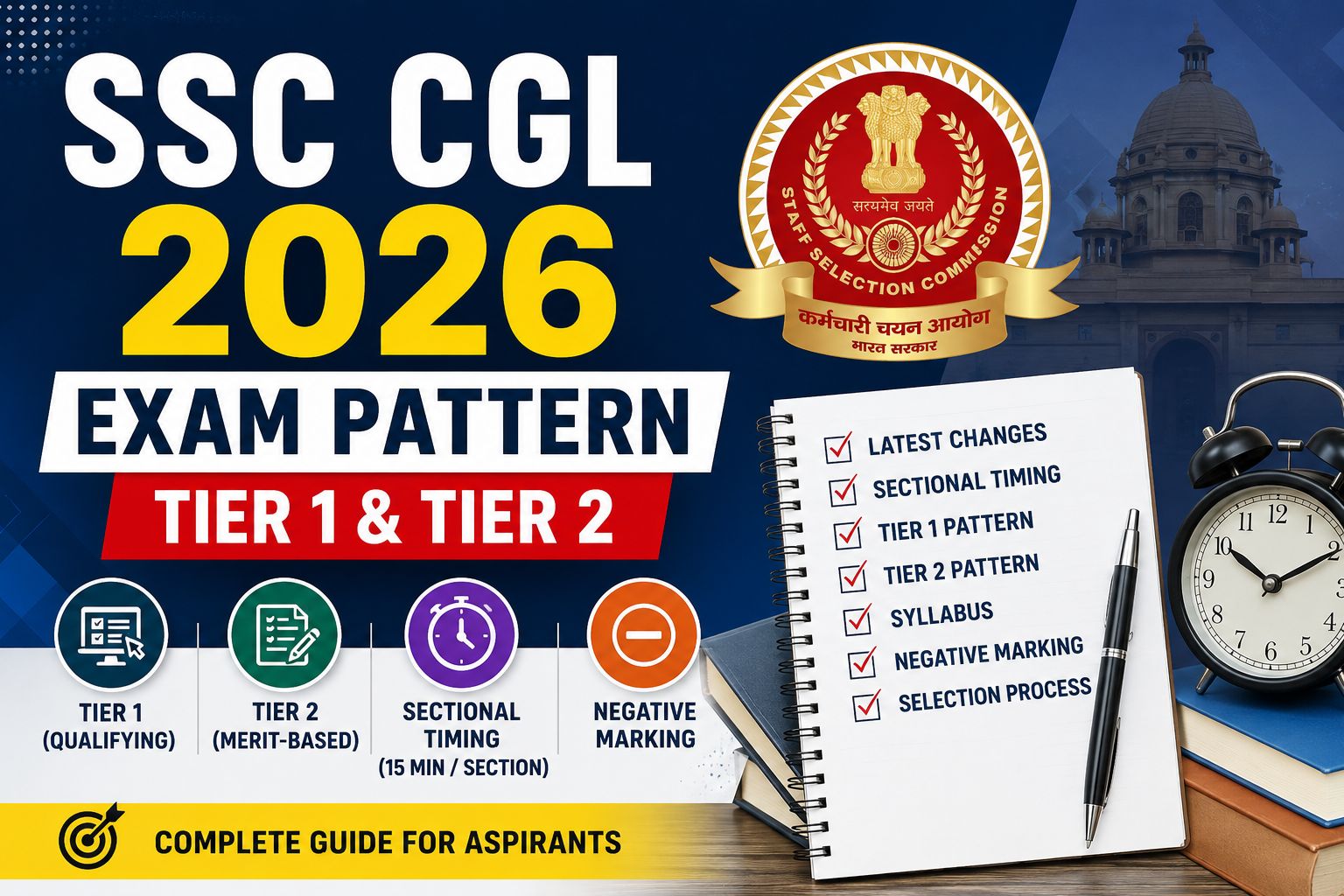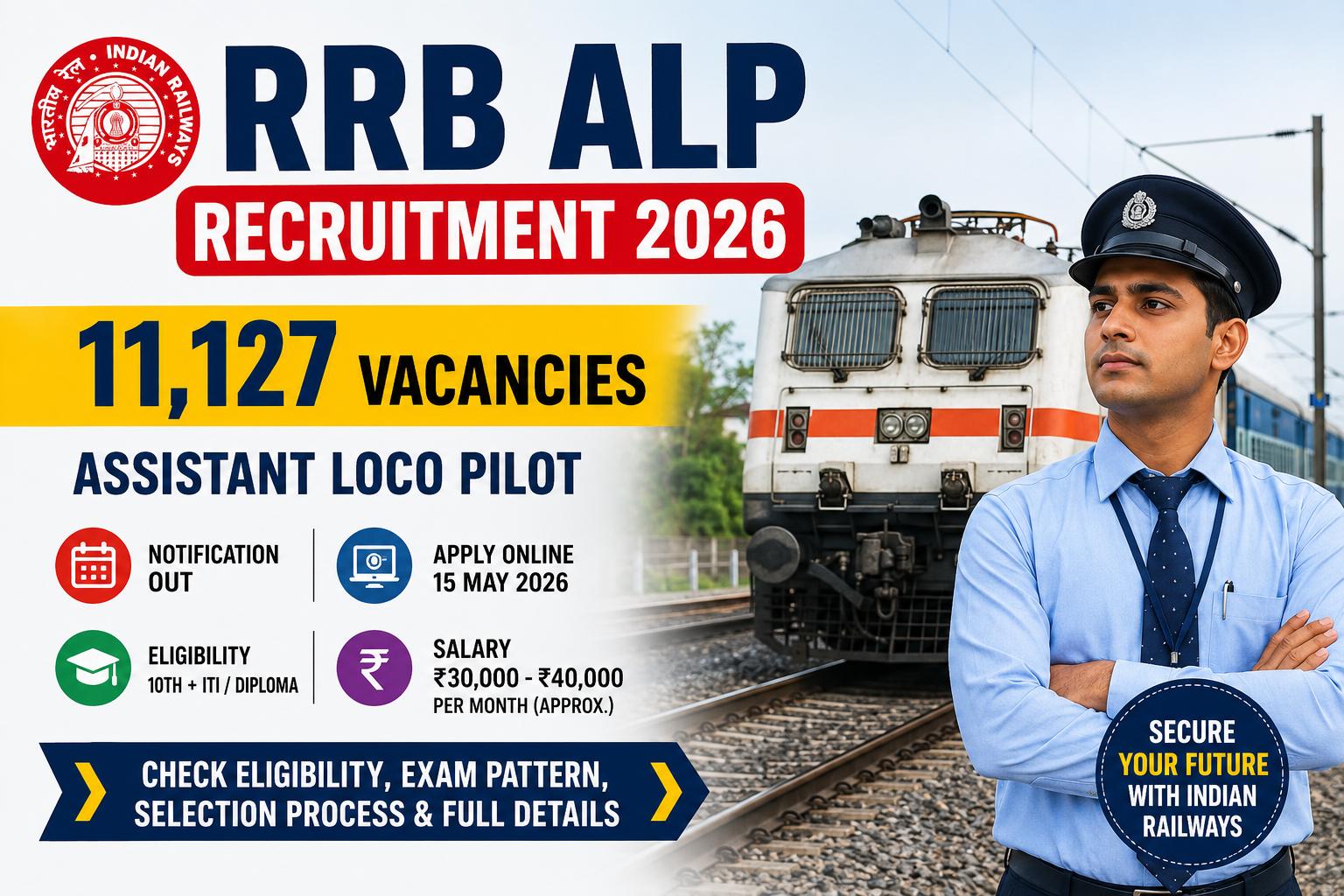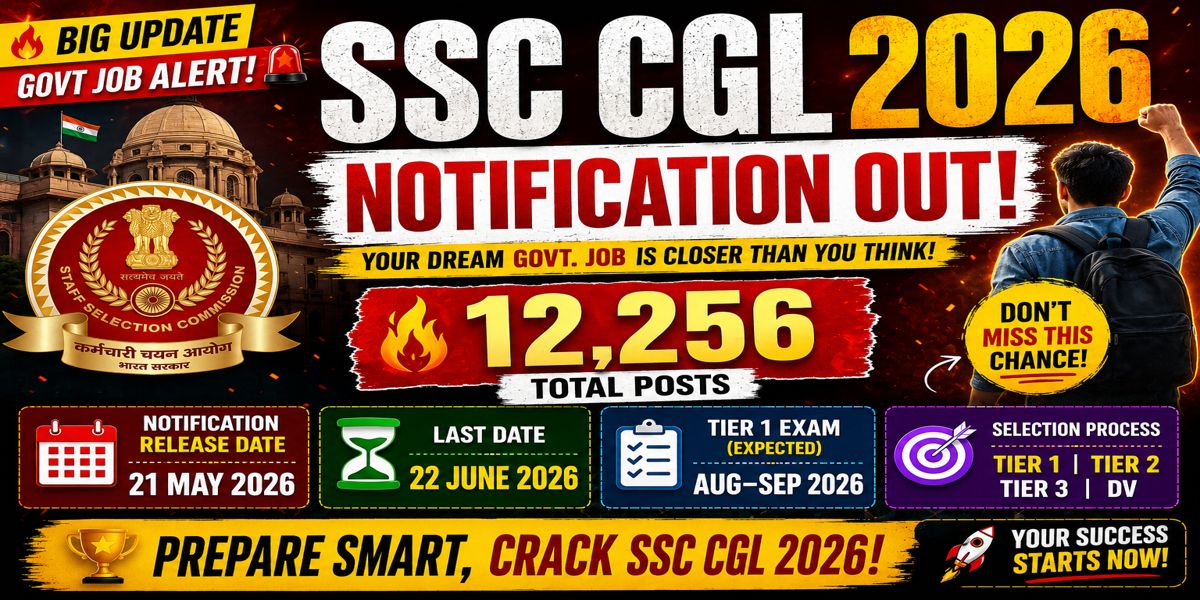
SSC Stenographer 2026 Notification Out: Apply Online for 731 Grade C and D Vacancies

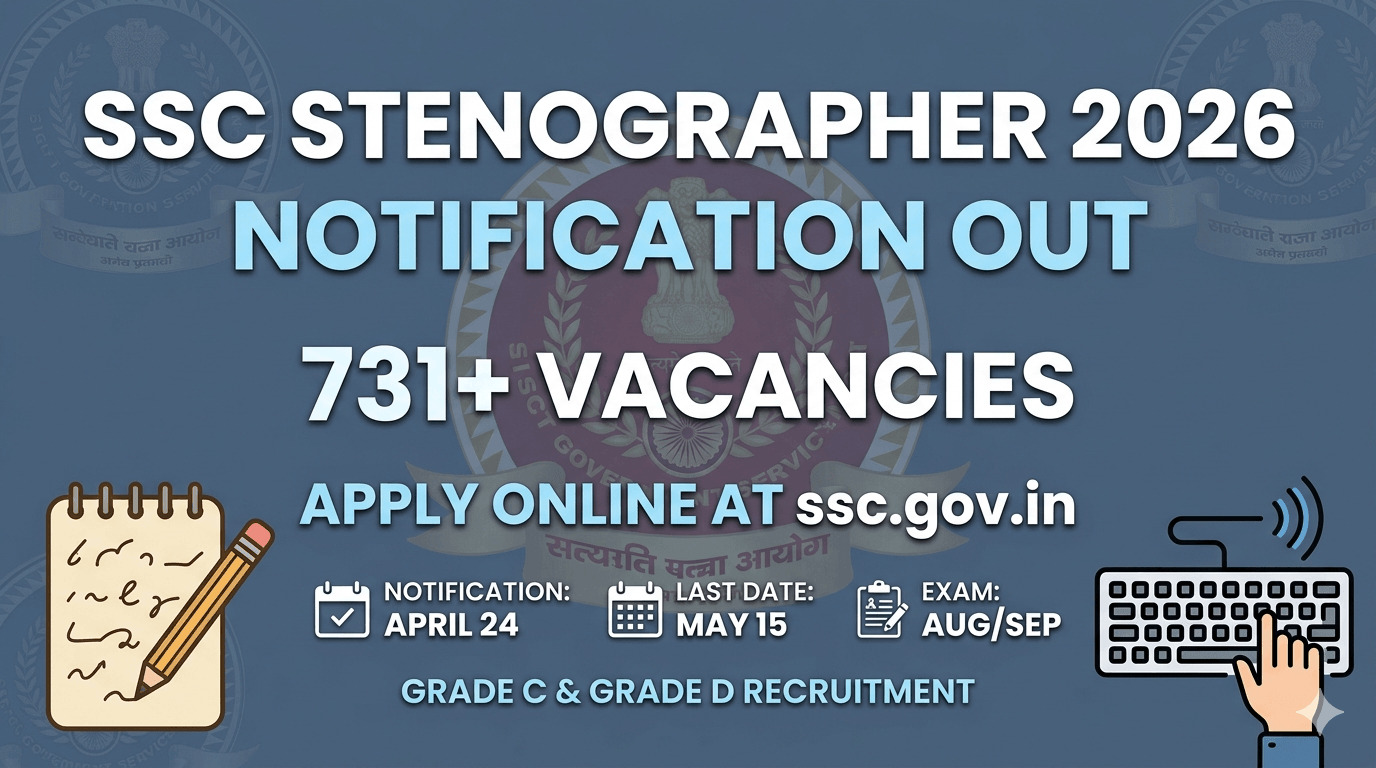
The Staff Selection Commission (SSC) has officially released the much-awaited SSC Stenographer 2026 notification on April 24, 2026. This recruitment drive aims to fill approximately 731 vacancies for Stenographer Grade C and Grade D posts across various Central Government Ministries, Departments, and Organizations. If you have been waiting for a stable government job with a focus on stenography skills, the window to apply is now open.

Aspiring candidates can submit their applications through the official SSC website at ssc.gov.in. It is important to note that the application process is strictly online. This year, the Commission has emphasized early registration to avoid the typical last-minute server congestion.


Important Dates for SSC Stenographer 2026 Recruitment

Staying updated with the recruitment timeline is crucial for every serious aspirant. Based on the official notification, here are the key dates you must remember:

Notification Release Date: April 24, 2026

Start Date for Online Application: April 24, 2026

​Last Date for Online Application: May 15, 2026 (by 23:00 hours)

​Last Date for Online Fee Payment: May 16, 2026

​Application Correction Window: May 20 to May 21, 2026

​SSC Stenographer CBT Exam Date: Scheduled for August or September 2026


Important Links for SSC Stenographer 2026:

Official Website: https://ssc.gov.in

Download Full Notification (PDF): Click Here to View/Download

Direct Link to Apply Online: Apply Now at ssc.gov.in


SSC Stenographer Vacancy 2026 Details

​While the notification currently mentions approximately 731 tentative vacancies, this number is subject to change. Historically, the SSC often increases the vacancy count as the recruitment process progresses and various departments report their final requirements. The vacancies are divided into two main categories:

​Stenographer Grade C: Generally higher-level posts with a higher pay scale, often located in Delhi-based ministries.

​Stenographer Grade D: Group C posts available in various offices across India.

​Candidates should check the official PDF for category-wise distribution (SC, ST, OBC, EWS, and UR) once the detailed vacancy chart is uploaded on the ‘Candidate’s Corner’ of the SSC website.


Eligibility Criteria for SSC Stenographer 2026

Before you proceed to fill out the form, ensure you meet the following eligibility requirements as of the cutoff date mentioned in the notification.

Educational Qualification:

Candidates must have passed the 12th standard (Intermediate) or an equivalent examination from a recognized Board or University. This is a great opportunity for higher secondary pass students to enter the central government services.

Age Limit (as of August 1, 2026):

Stenographer Grade C: 18 to 30 years.

Stenographer Grade D: 18 to 27 years.

Age relaxation is applicable for reserved categories such as SC/ST (5 years), OBC (3 years), and PwBD as per the existing Government of India rules.


SSC Stenographer 2026 Selection Process

​The selection process is divided into two major stages. Unlike many other SSC exams, there is no Tier 2 written exam; instead, the skill test is the deciding factor.

1. Computer Based Examination (CBT):

The online exam consists of objective-type multiple-choice questions. The subjects included are:

  • ​General Intelligence and Reasoning (50 Questions)
  • ​General Awareness (50 Questions)
  • English Language and Comprehension (100 Questions)
  • Total Marks: 200. Duration: 2 Hours.

Please note that there is a negative marking of 0.25 marks for each wrong answer.


2. Skill Test in Stenography:

Candidates who clear the CBT cutoff will be called for the Skill Test. This test is qualifying in nature.

  • For Grade C: Dictation at 100 words per minute (wpm).
  • For Grade D: Dictation at 80 words per minute (wpm).

Candidates will have to transcribe the dictation on a computer within the specified time limit.


How to Apply Online at ssc.gov.in

​Follow these steps to complete your application smoothly:

  1. ​Visit the official website: ssc.gov.in
  2. ​If you are a new user, complete the ‘One Time Registration’ (OTR). If you already have an OTR for the new portal, simply log in.
  3. Navigate to the ‘Apply’ tab and select ‘Stenographer Grade C & D Examination 2026’.
  4. Fill in the required details, including your educational background and preferred exam centers.
  5. ​Upload your recent photograph and signature according to the specified dimensions.
  6. Pay the application fee of Rs. 100 (Women, SC, ST, PwBD, and ESM candidates are exempted from payment).
  7. ​Review your application and submit. Take a printout for future reference.


Preparation Strategy for the 2026 Exam

​With the exam scheduled for August/September, you have approximately four months to prepare. Focus heavily on the English Language section as it carries 50% of the total weightage. Improving your reading comprehension and grammar will give you a significant edge. Simultaneously, dedicate at least one hour daily to shorthand practice to ensure you are ready for the skill test immediately after the results.

​For more updates on government job notifications and study material, keep visiting our blog and subscribe to our newsletter.


SSC Stenographer Salary 2026: 7th Pay Commission Benefits

One of the biggest motivations for this exam is the attractive salary and perks provided by the Central Government. The pay structure is determined by the 7th Pay Commission and depends on the city of posting (X, Y, or Z category cities).

Stenographer Grade C Salary:

Grade C posts are generally Group B (Non-Gazetted) positions. The pay scale ranges from Rs. 9,300 to Rs. 34,800 with a Grade Pay of Rs. 4,200 or Rs. 4,600.

​In-hand Salary: Approximately Rs. 51,000 to Rs. 60,000 per month.

Stenographer Grade D Salary:

Grade D posts are Group C positions. The pay scale is Rs. 5,200 to Rs. 20,200 with a Grade Pay of Rs. 2,400.

​In-hand Salary: Approximately Rs. 36,000 to Rs. 43,000 per month.


SSC Selection Post Phase 14 Syllabus and Exam Pattern 2026: The Complete Guide

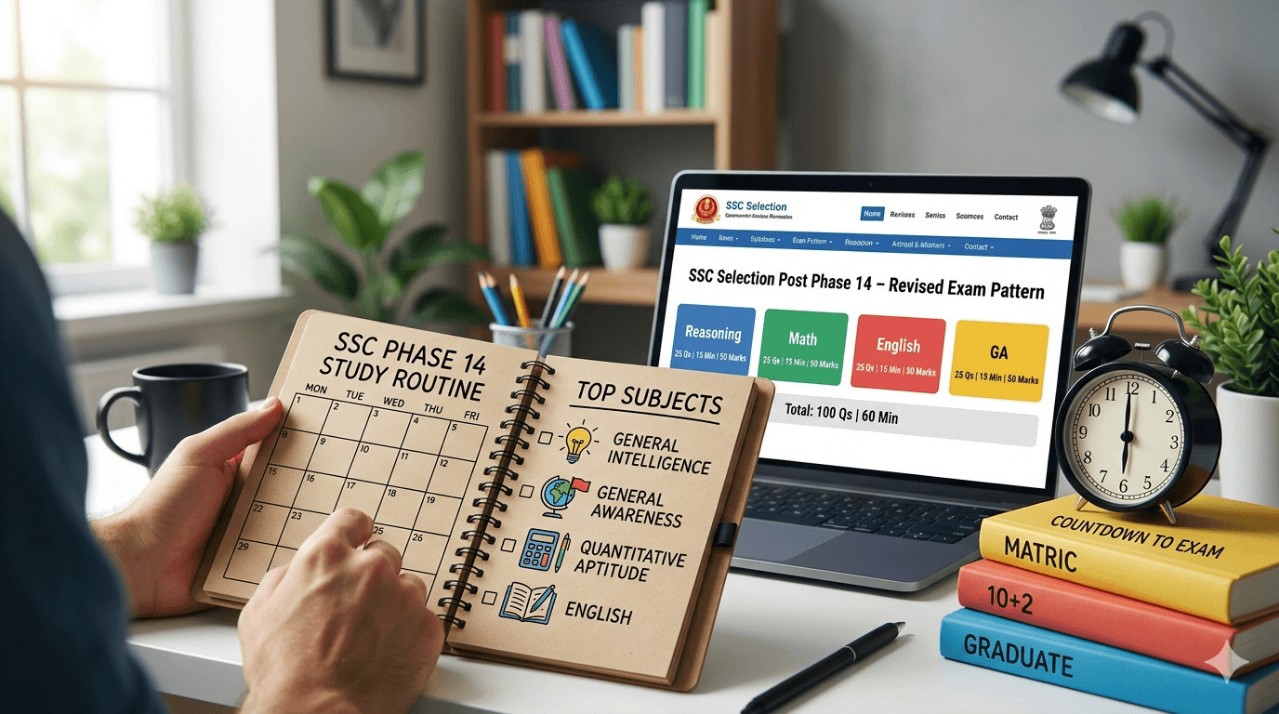
SSC Selection Post Phase 14 Syllabus and Revised Exam Pattern 2026 Infographic showing study routine and subjects

The Staff Selection Commission has officially released the SSC Selection Post Phase 14 Notification 2026, announcing 2,919 vacancies across various departments. If you have already checked the notification details we published earlier, your next crucial step is mastering the SSC Selection Post Phase 14 Syllabus and Exam Pattern.

​This guide provides a detailed breakdown of the topics you need to cover and the structure of the computer-based examination to help you secure a seat in this recruitment cycle.


Important Dates for SSC Selection Post Phase 14

​Notification Release: 13th April 2026

Application Window: 13th April to 4th May 2026

​Correction Window: 11th May to 13th May 2026

​CBT Exam Date: June 2026 (Tentative)


Important Links for SSC Phase 14 Recruitment 2026

​Download Official Notification PDF: [“Click Here to Download SSC Phase 14 Notification“]

Direct Link to Apply Online: [https://ssc.gov.in/login]

Check Post Codes & Requirements: [View Post Details]

Official SSC Website: [ssc.gov.in]

SSC Selection Post Phase 14 Exam Pattern 2026

​Understanding the exam pattern is the foundation of a solid preparation strategy. The Phase 14 exam is a Computer Based Examination (CBE) consisting of objective-type, multiple-choice questions.

Key Highlights of the Exam Pattern:

Total Questions: 100

Total Marks: 200

Duration: 60 Minutes (80 minutes for candidates eligible for scribes)

Marking Scheme: Each correct answer earns 2 marks.

Negative Marking: There is a penalty of 0.50 marks for every wrong answer.

Sections: The paper is divided into four parts, each containing 25 questions.

Section-wise Distribution:

​General Intelligence: 25 Questions (50 Marks)

General Awareness: 25 Questions (50 Marks)

Quantitative Aptitude: 25 Questions (50 Marks)

English Language: 25 Questions (50 Marks)


Detailed SSC Selection Post Phase 14 Syllabus

​The syllabus varies slightly based on the educational qualification required for the post (Matriculation, Higher Secondary, or Graduation). However, the core subjects remain the same.

​1. General Intelligence and Reasoning

​This section tests your logical thinking and problem-solving abilities.

Topics: Semantic Analogy, Symbolic/Number Analogy, Figural Analogy, Semantic Classification, Symbolic/Number Classification, Figural Classification, Semantic Series, Number Series, Figural Series, Problem Solving, Word Building, Coding & Decoding, Numerical Operations, Symbolic Operations, Trends, Space Orientation, Venn Diagrams, Drawing Inferences, Punched Hole/Pattern-Folding & Unfolding, Critical Thinking, Emotional Intelligence, and Social Intelligence.

2. General Awareness

​This section evaluates your knowledge of current events and everyday observations.

Topics: India and its neighboring countries, Sports, History, Culture, Geography, Economic Scene, General Polity including the Indian Constitution, and Scientific Research. Stay updated with the latest Current Affairs 2026 to score high here.

3. Quantitative Aptitude

​This tests your comfort level with numbers and mathematical concepts.

Topics: Number Systems, Computation of Whole Numbers, Decimals and Fractions, Relationship between Numbers, Fundamental Arithmetical Operations, Percentage, Ratio and Proportion, Averages, Interest (Simple and Compound), Profit and Loss, Discount, Use of Tables and Graphs, Mensuration, Time and Distance, Ratio and Time, and Time and Work.

4. English Language

​Candidates are tested on their basic understanding of the English language.

Topics: Vocabulary, Grammar, Sentence Structure, Synonyms, Antonyms and their correct usage, Spotting Errors, Fill in the Blanks, Idioms and Phrases, One-word Substitution, Improvement of Sentences, Active/Passive Voice, and Cloze Passage or Comprehension Passage.


Preparation Hacks for Phase 14 2026

Analyze Post-Wise Level: If you apply for multiple levels, you must appear for separate exams for each level. Prepare for the highest level you are eligible for to cover all bases.

The 0.50 Penalty Rule: Negative marking is high. Only attempt questions you are at least 80% sure about.

Focus on Arithmetic: In the Quantitative Aptitude section, Arithmetic usually carries 60–70% weightage. Master this before moving to Advance Maths.

Speed Practice: With the new 15-minute sectional timer, you cannot spend too much time on one section. You must practice finishing each 25-question set within the 15-minute window.


Preparation Strategy and What is Next?

Now that you are familiar with the SSC Selection Post Phase 14 Exam Pattern, it is time to move from theory to action. Many aspirants fail because they lack a structured routine despite knowing the syllabus.

Stay tuned for our upcoming posts where we will provide:

SSC Selection Post 90-Day Study Plan: A day-by-day roadmap to cover the entire syllabus before June.

Topic-wise Practice Mocks: Specialized questions for high-weightage topics.

​Previous Year Question (PYQ) Analysis: Insights into which topics SSC repeats the most.


Success in the SSC Selection Post Phase 14 2026 exam requires consistency. Start by mastering the basics of each subject and then move to solving full-length mock tests to improve your speed and accuracy.


​Karnataka SSLC Result 2026 Link: How to Check KSEAB 10th Result Online Today

How to check Karnataka SSLC Result 2026 online at 12 PM link

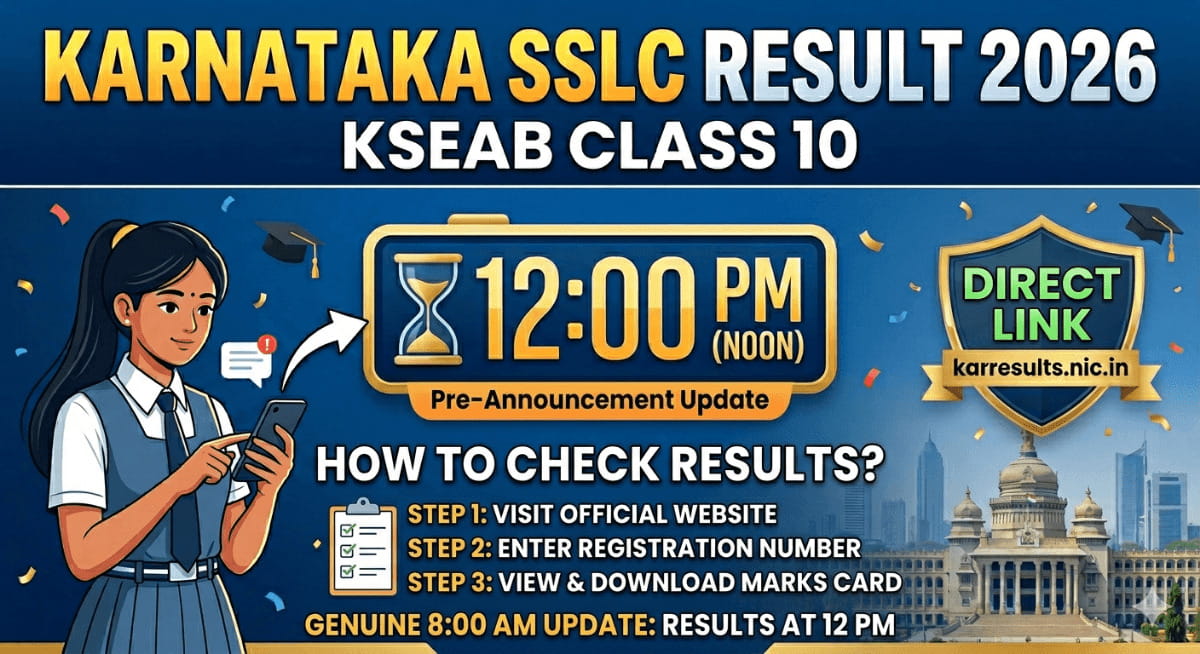
The big day is finally here. Today, April 23, 2026, the Karnataka School Examination and Assessment Board (KSEAB) will officially release the Karnataka SSLC Result 2026. More than 8 lakh students across the state are waiting to see their Class 10 scores.

​According to the official announcement by the Education Department, the results will be declared in a press conference this morning, and the online link will be activated at 12:00 PM. This guide provides the fastest way to access your marks card and what to do if the official website, karresults.nic.in, stops responding due to high traffic.


Karnataka SSLC Result 2026: Today’s Official Schedule

If you are checking this early in the morning, please note the official timing for today’s events:

8:00 AM – 10:00 AM: Final preparations at the KSEAB headquarters in Bengaluru.

10:30 AM: Official Press Briefing begins (Pass percentage and toppers announced).

12:00 PM: Direct Link Activation for students to check individual results.

Official Website: karresults.nic.in


How to Check Karnataka 10th Result 2026 Online Today

To ensure you are among the first to see your result, follow these steps exactly when the clock strikes 12:00 PM:

  1. Visit the Official Portal: Navigate to karresults.nic.in or kseab.karnataka.gov.in.
  2. Click the Live Link: Look for the bold text that says “SSLC Examination-1 Result 2026”.
  3. Enter Registration Number: You will need your 11-digit Registration Number from your hall ticket.
  4. Select Date of Birth: Use the built-in calendar to select your correct birth date.
  5. View and Save: Click on the ‘Submit’ button. Once your marks card appears, immediately take a screenshot or download the PDF.


What to do if karresults.nic.in is not working?

​It is very common for the official website to show a “Server Busy” or “Site Cannot Be Reached” error between 12:00 PM and 1:00 PM today. If this happens, do not panic. Use these alternative methods to get your Karnataka 10th Result:

Method 1: Check via SMS (No Internet Required)

  • ​This is the most reliable way to get your marks when the servers are down.
  • ​Open your messaging app.
  • Type: KSEEB10 [Your Registration Number]
  • Send to: 56263
  • ​You will receive a text message with your subject-wise scores shortly.

Method 2: Use DigiLocker

​The Karnataka Board has partnered with DigiLocker to provide verified digital marks cards.

  • ​Login to your DigiLocker account.
  • Go to the ‘Education’ section and select ‘KSEAB’.
  • Enter your details to fetch your digital-signed marks card. This document is valid for Class 11 (PUC) admissions.


Important Details on the Karnataka SSLC Marks Card 2026

When you download your result today, make sure to check the following details for any spelling errors:

  • ​Student Name and Father’s Name
  • ​Registration Number
  • Subject-wise Internal Assessment Marks
  • ​Subject-wise Theory Marks
  • ​Final Result Status (Pass/Fail)

Passing Marks: Every student must score a minimum of 35% marks in each subject. If you have secured exactly 35, you have cleared the examination. For those who narrowly miss the mark, the board may apply grace marks based on today’s final policy decision.


Karnataka SSLC Toppers List and District Performance 2026

​The KSEAB will announce the list of students who secured a perfect 625/625 score during the 10:30 AM press conference. Historically, districts like Udupi, Dakshina Kannada, and Chikkaballapur have topped the state in terms of pass percentage. We will update this section with the live district-wise rankings as soon as they are announced.


What if You Are Not Happy with the Result?

​If your marks are lower than expected, you have two main options provided by the board:

Re-evaluation & Scanned Copies: You can apply for a scanned copy of your OMR or answer sheet starting tomorrow. If you find a counting error, you can apply for re-totalling.

SSLC Exam-2 (Supplementary): For students who failed to clear a subject or wish to improve their percentage, the Karnataka SSLC Supplementary Exam-2 will be held in June 2026. You can register for this through your school starting next week.


Conclusion

​We wish all the students the very best for their Karnataka SSLC Result 2026. Stay calm, keep your hall ticket ready, and keep refreshing this page for the direct link.

SSC GD 2026: How to Prepare in Short Time? Final 10-Day Revision Strategy

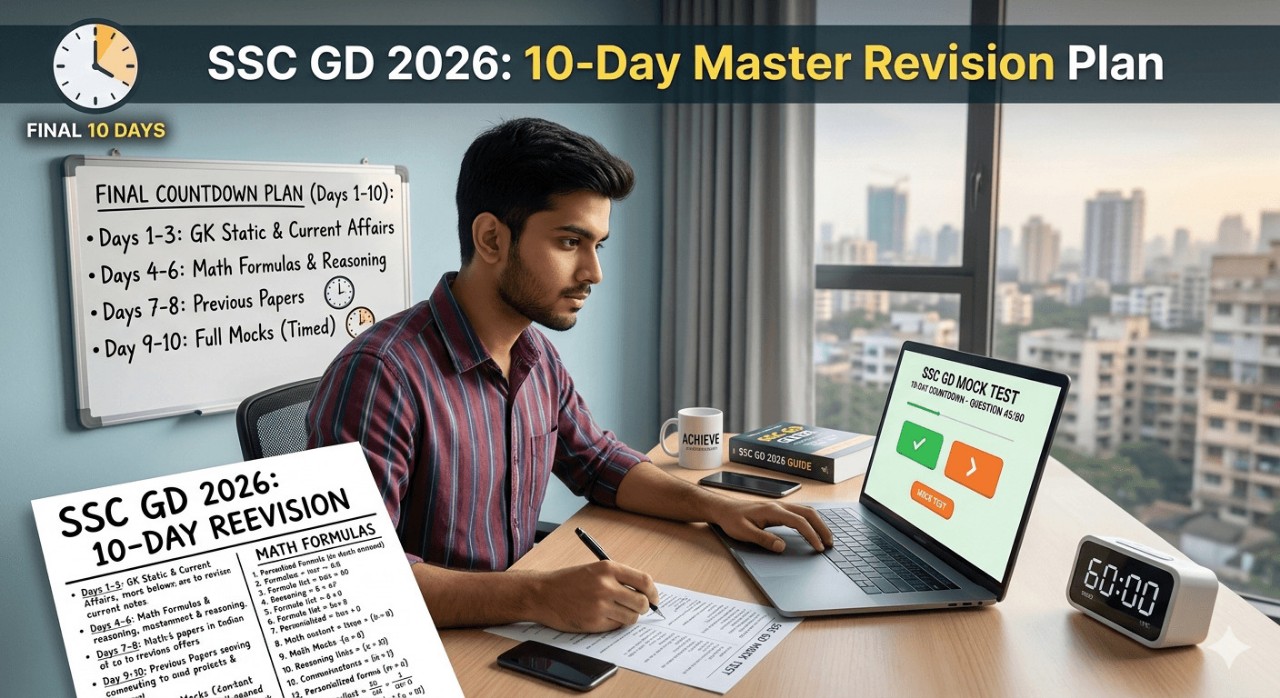
Student studying for SSC GD 2026 with a 10-day master revision plan and mock test on laptop

The Staff Selection Commission has officially released the SSC GD City Intimation. Now that you know your exam date and city, the countdown has truly begun. For many aspirants, this is the moment of realization: “Is there enough time to finish the syllabus?”

​The answer is Yes. But you cannot study like you did three months ago. You need a “Smart Revision” approach rather than a “Full Study” approach. In this guide, we will break down exactly what to focus on to maximize your score in these final days.


1. Understand the Reality: Quality Over Quantity

​With the exam just days away, do not try to pick up brand-new, difficult chapters. If you haven’t mastered Trigonometry or Advanced Algebra yet, leave them. SSC GD is a matriculation-level exam where speed and accuracy in basic topics carry more weight than complex problem-solving.

The 80/20 Rule for SSC GD

​Focus on the 20% of the syllabus that generates 80% of the marks. In the SSC GD 2026 pattern, you have 80 questions to solve in just 60 minutes. This means you have less than 45 seconds per question.


2. Subject-Wise “Must-Revise” Topics

​If you are short on time, ensure these specific topics are on your fingertips:

​Elementary Mathematics (20 Questions)

​Math is the section where you can score a perfect 40/40 if your basics are clear.

​Profit, Loss, and Discount: Expect 3-4 questions. Memorize the relationship between CP, SP, and MP.

​Percentage & Ratio: These are the “base” of math. Most questions can be solved using ratio methods.

​Time, Speed, and Distance: Focus on “Average Speed” and “Relative Speed” (train problems).

​Mensuration: Simply memorize the formulas for Area and Volume (Cylinder, Cone, Sphere). SSC rarely asks deep conceptual questions here; they are usually formula-based.


​General Intelligence & Reasoning (20 Questions)

​This is the highest-scoring section. Don’t spend hours here; just practice.

​Coding-Decoding: Practice 50 questions to recognize patterns quickly.

​Number Series: Focus on square/cube patterns and “gap-of-gap” logic.

​Syllogism: Use Venn diagrams to avoid confusion.

​Seating Arrangement: Practice 1-2 linear and circular arrangements daily to reduce your solving time.


​General Knowledge & Awareness (20 Questions)

​The syllabus is vast, so stay focused:

​Static GK: Focus on Indian Folk Dances, Festivals, National Parks, and Census 2011.

​Current Affairs: Revise the last 6-8 months. Focus on Sports (IPL/World Cup), Awards, and New Appointments.

​Polity: Articles related to Fundamental Rights and the President are favorites of SSC.


Important Note: Before starting your revision, make sure you have checked your exam date and center location. If you haven’t seen it yet, read our guide on how to download the SSC GD City Intimation Slip 2026 here.

Visit the Official Website: Go to ssc.gov.in.

3. The 10-Day “Power Revision” Schedule

​Use this table to organize your final days. Stick to this strictly to avoid burnout.

Days 1 to 3: The Weak Link Phase

Identify the topics where you feel 50% confident. Do not touch things you know nothing about. Instead, watch “one-shot” revision videos for these middle-ground topics and solve 20 practice questions for each.

​Days 4 to 6: Formula and Logic Mastery

Spend these three days cementing your speed. Revise every Math formula and Reasoning shortcut. You should also start solving one full-length mock test daily during the exact time slot of your actual exam.

Days 7 to 8: General Awareness Marathon

Read 6-month compilation PDFs. Focus on “Who’s Who” and major sports updates from late 2025 and early 2026. This is purely a memory game, so repeat the facts aloud.

Day 9: Previous Year Focus

Solve at least three or four actual papers from the 2024 or 2025 recruitment cycles. This helps you understand the “language” of the questions SSC likes to ask.

Day 10: Mental Preparation

Stop heavy studying by noon. Review your personal formula sheet, double-check your exam center location from the city intimation, and rest your mind.


4. The “Mock Test” Secret

​Many students make the mistake of solving mocks but not analyzing them. After the City Intimation is out, your mock test strategy should change:

​Timed Practice: Always solve mocks in 60 minutes. No pauses.

​Order of Attempt: Try starting with GK (5 mins) \rightarrow Hindi/English (7 mins) \rightarrow Reasoning (18 mins) \rightarrow Math (25-30 mins). This ensures you see every question in the paper.

​The “Skip” Art: If a Math question takes more than 1 minute, SKIP IT. Mark it for review and move on. Every question carries equal marks; don’t die on one difficult question.


5. Avoiding Negative Marking

​Since there is a 0.25 negative marking, accuracy is your best friend.

​If you are 100% sure, mark it.

​If you can eliminate two options, take a calculated risk.

​If you have no idea, leave it. Scoring 0 is better than scoring -0.25.


6. Essential Document Checklist for Exam Day

​Now that you have seen your City Intimation, you will soon be able to download the full Admit Card (usually 4 days before your exam date). Prepare a small folder now with the following items to avoid last-minute panic:

​Printout of the Admit Card: Preferably a clear color printout.

​Original Photo ID Proof: This must have the same Date of Birth as mentioned on your application (Aadhaar Card, Voter ID, or Driving License).

​Recent Passport Size Photographs: Carry at least two copies, identical to the one uploaded in the form.

​Transparent Water Bottle: Most centers only allow clear bottles without any labels.


Conclusion

​The SSC GD 2026 exam is a test of your speed and mental toughness. Since the City Intimation is already in your hands, stop worrying about what you haven’t studied and start perfecting what you have. Consistency in these final 10 days can be the difference between a “Qualified” and “Not Qualified” status.

​Stay focused, keep your admit card details ready, and give it your best shot!


SSC GD City Intimation Slip 2026 Released: Check Your Exam City, Date, and Shift Timing Now

SSC GD City Intimation Slip 2026 Release Official Notification

The wait is finally over for lakhs of aspirants appearing for the SSC GD Constable Examination 2026. The Staff Selection Commission (SSC) officially released the SSC GD City Intimation Slip 2026 on April 19, 2026. This slip is a crucial document for candidates to identify their allotted exam city and schedule their travel and logistics well in advance.

​If you are one of the candidates who applied for the Constable (General Duty) posts in CAPFs, SSF, Assam Rifles, or Sepoy in NCB, this guide will walk you through everything you need to know about downloading your city slip and preparing for the upcoming exam.


SSC GD 2026 Exam Overview

​The SSC GD Constable recruitment drive aims to fill 25,487 vacancies across various paramilitary forces. The selection process is highly competitive, consisting of a Computer-Based Test (CBT), followed by Physical Efficiency (PET) and Medical Tests.

EventDetails
Organization Staff Selection Commission (SSC)
Exam Name SSC GD Constable 2026
Total Vacancies 25,487
City Slip Release Date April 19, 2026
CBT Exam Dates April 27 to May 30, 2026

Official Website: ssc.gov.in

Read more

🚨 SSC Selection Post 2026 Notification OUT – Apply Now | Eligibility, Vacancy, Salary, Last Date (Full Details)

SSC Selection Post Phase XIV 2026 All India Notification 3003 Vacancies Job Alert
🔥 Big Opportunity for Government Job Aspirants!
The Staff Selection Commission has released the SSC Selection Post Phase 14 Notification 2026, opening doors for thousands of candidates across India.
👉 Whether you are 10th pass, 12th pass, or a graduate, this recruitment offers a wide range of opportunities in different departments.
💡 If you’re serious about getting a government job, don’t skip this chance!


Why This Notification is Different (And Better!)

​Most big websites just copy-paste the notification. But at Namma Govt Job, we analyze the “why.” The Selection Post is unique because:

​Lower Competition: Because people find the “Post Code” system confusing, fewer people apply for specific technical posts.

Single Exam: You only need to clear one computer-based test to move to the scrutiny stage.

​Variety: From Laboratory Attendants in Karnataka to Clerks in Delhi, the options are massive.


📅 Important Dates Selection Post Phase XIV You Must Remember!

Notification Release: April 13, 2026

Online Application Start: April 13, 2026

Last Date to Apply: May 04, 2026 (Until 11:00 PM)

​Last Date for Online Fee Payment: May 05, 2026

Admit Card Release: June 2026

Exam Date: June–July 2026


📊 Total Vacancies Selection Post Phase XIV

The 3003 vacancies are spread across different categories. This year, the distribution is quite balanced, giving a fair chance to everyone:

👉 Vacancies are distributed across multiple ministries, departments, and regions.

Unreserved (UR): 1534 Posts

​OBC: 667 Posts

​SC: 346 Posts

​ST: 185 Posts

​EWS: 271 Posts

​These vacancies are divided into three levels: Matriculation (10th), Higher Secondary (12th), and Graduation & Above.


🎯 Eligibility Criteria: Can You Apply?

One of the most common questions we get is about eligibility. The age and education are calculated as of January 01, 2026.

🧑‍🎓 Educational Qualification

For 10th Level Posts: You must have passed Class 10 from a recognized board.

​For 12th Level Posts: You must have passed Class 12 (10+2) or equivalent.

​For Graduate Level Posts: A Bachelor’s degree in any stream. Some specialized posts might ask for specific subjects like Biology, Chemistry, or Library Science.

👉 Each post has specific requirements, so read carefully before applying.


🎂 Age Limit

Minimum Age: 18 years

Maximum Age: 30 years (varies by post)

👉 Age relaxation:

OBC: +3 years

SC/ST: +5 years

PwD: As per rules


💼 Types of Posts Available

Some common posts include:

Clerk

Data Entry Operator (DEO)

Laboratory Assistant

Junior Engineer

Technical Staff

Multi-Tasking Staff (MTS)

👉 Posts vary based on qualification and department.


The “Post Code” Strategy: Don’t Make This Mistake!

​This is where 50% of students fail. You don’t just apply for “Phase 14.” You apply for a Post Code (Example: KK10226).

​How to Choose a Post:

  • ​Go to the official SSC website and look for the “Post Details” link.
  • Filter by your region (e.g., KKR for Karnataka-Kerala Region).
  • Look for “Essential Qualification” (EQ). If a post asks for “1-year experience in a Lab,” and you don’t have it, do not apply. You will be rejected during scrutiny even if you top the exam.
  • Search for posts that only ask for “10th Pass” or “12th Pass” with no extra experience. These have more competition but are safer if you are a fresh candidate.


💰 Salary Structure

Salary Range: ₹18,000 to ₹81,000 per month

Pay Level: Level 1 to Level 7

Additional Benefits:

✔ Dearness Allowance (DA)

✔ House Rent Allowance (HRA)

✔ Medical Benefits

✔ Pension & Job Security

👉 Government jobs offer long-term stability and growth.


📝 Selection Process

The recruitment process includes:

1️⃣ Computer-Based Test (CBT)

Objective-type exam

Conducted online

2️⃣ Skill Test (if required)

Typing / Data Entry / Practical (post-specific)

3️⃣ Document Verification

Final stage before selection


📚 Exam Pattern (CBT)

Total Questions: 100

Total Marks: 200

Duration: 60 minutes

Subject Wise Distribution:

  • ​General Intelligence (Reasoning): 25 Questions (50 Marks)
  • General Awareness (GK/Current Affairs): 25 Questions (50 Marks)
  • Quantitative Aptitude (Maths): 25 Questions (50 Marks)
  • ​English Language: 25 Questions (50 Marks)

​Important Note on Negative Marking:

Each correct answer gives you 2 marks. However, there is a heavy negative marking of 0.50 marks for every wrong answer. Accuracy is more important than speed here!


💸 Application Fee

General/OBC: ₹100

SC/ST/PwD/Female Candidates: No Fee


📲 Step-by-Step: How to Apply Online

  1. Visit the official SSC website
  2. Complete registration (if new user)
  3. Log in with credentials
  4. Fill application form carefully
  5. Upload photo & signature
  6. Pay application fee
  7. Submit form and download confirmation

👉 Always keep a copy for future reference.


Important Links for SSC Phase 14 Recruitment 2026

​Download Official Notification PDF: [“Click Here to Download SSC Phase 14 Notification“]

Direct Link to Apply Online: [Apply Here @ssc.gov.in]

​Check Post Codes & Requirements: [View Post Details]

​Official SSC Website: [ssc.gov.in]


🔥 Why SSC Selection Post is Important?

✔ Huge number of vacancies

✔ Suitable for all education levels

✔ Less competition compared to CGL

✔ Easier exam pattern

✔ Government job benefits

👉 Many candidates ignore this exam — which gives you an advantage!


📈 Preparation Tips (Must Read)

If you want to crack this exam:

✔ Focus on Basics

NCERT-level math & reasoning

Daily current affairs

✔ Practice Mock Tests

Improve speed & accuracy

✔ Time Management

Don’t spend too much time on one question

✔ Previous Year Papers

Understand exam pattern deeply

👉 Consistency is the key to success.


Common Mistakes to Avoid

Applying without checking eligibility

Waiting till last date

Ignoring syllabus

Not practicing mock tests

👉 Avoid these and you’ll already be ahead of many candidates.


Frequently Asked Questions (FAQs)

Q1. Who can apply for SSC Selection Post?

👉 Candidates who are 10th pass, 12th pass, or graduates can apply.

Q2. Is there an interview?

👉 No, selection is based on CBT + skill test (if required).

Q3. Is this exam tough?

👉 It is easier compared to SSC CGL, but competition still exists.

Q4. Can final-year students apply?

👉 Only if they meet eligibility before the deadline.

Q5. Is this a permanent job?

👉 Yes, most posts are permanent government jobs.


🚀 Pro Tip for Serious Aspirants

If you are preparing for exams like SSC CGL, this exam works as:

👉 Practice + Real exam experience

👉 Confidence booster

👉 Backup opportunity


📢 Final Words

The Staff Selection Commission Selection Post Phase 14 is a golden opportunity for lakhs of aspirants.

📌 Apply early

📌 Start preparation today

📌 Don’t miss this chance

👉 Share this article with your friends so they don’t miss this opportunity!


Indian Bank SO Recruitment 2026 Notification Out: Apply for 350 Specialist Officer Posts

Official notification for Indian Bank Specialist Officer SO Recruitment 2026 showing 350 vacancies.

​Great news for banking aspirants! Indian Bank has officially released a massive recruitment notification today, April 8, 2026, for the position of Specialist Officers (SO). If you have been waiting for a stable, high-paying government job in the banking sector, this is a golden opportunity to join one of India’s leading Public Sector Banks.

​This recruitment drive aims to fill 350 vacancies across various scales and specializations, including Assistant Manager (Scale I), Manager (Scale II), and Senior Manager (Scale III).

​In this comprehensive guide, we will cover everything you need to know about the Indian Bank SO Recruitment 2026, including eligibility criteria, important dates, application fees, and the selection process.


Indian Bank SO Recruitment 2026: Important Dates

​Staying updated with the timeline is crucial to ensure you don’t miss the deadline. The registration window is short, so mark your calendars:

Notification Release Date:   April 8, 2026

Online Registration Starts:   April 8, 2026

Last Date to Apply Online:   April 28, 2026

Last Date for Fee Payment:  April 28, 2026

Online Exam Date:                  To be Announced (TBA)

Interview Schedule:                To be Announced (TBA)


Vacancy Details by Post

​The 350 vacancies are distributed across several technical and professional departments. Some of the key roles include:

Information Technology (IT)

​Finance & Credit

​Risk Management

​Marketing

​Human Resource Management

​Civil Engineering & Architecture

​These posts are divided into Scale I (Assistant Manager), Scale II (Manager), and Scale III (Senior Manager) based on the required experience and expertise.


Eligibility Criteria

​Before applying, candidates must ensure they meet the specific requirements set by Indian Bank.

1. Educational Qualification

​The required qualification varies depending on the specific post code. Generally, the following degrees are accepted:

IT/Software: B.E./B.Tech in Computer Science/IT or MCA.

Finance/Credit: MBA (Finance), CA, ICWA, or CFA.

Generalist Roles: Post-graduation in relevant fields like HR, Marketing, or Statistics.

Engineering: Degree in Civil Engineering or Architecture for specific technical posts.

2. Age Limit (as of April 1, 2026)

​The age limit depends on the Scale of the post:

Scale I: 22 to 30/32 years.

Scale II: 25 to 35 years.

Scale III: 27 to 38 years.

​(Note: Age relaxation is applicable for reserved categories—5 years for SC/ST, 3 years for OBC, and 10 years for PwBD candidates.)


Indian Bank SO Exam Pattern & Syllabus

​If the bank receives a high volume of applications, an online test will be conducted. Here is the expected pattern:

SubjectQuestionsMarksDuration
Professional Knowledge 60 120 2 Hours (Composite)
Reasoning Ability 40 40
English Language 20 20
Quantitative Aptitude 40 40
Total 160 220 120 Minutes


Selection Process

​Indian Bank follows a structured selection process to ensure the best talent is recruited. Depending on the number of applications received, the bank may choose one of the following methods:

Shortlisting & Interview: Based on the candidate’s profile, followed by a personal interview.

Written/Online Test & Interview: * The written test typically consists of 120 questions carrying 180 marks.

The duration is 2 hours.

​Negative Marking: There is a penalty of 1/4th mark for every wrong answer.

Qualifying Marks: 40% for General/EWS and 35% for SC/ST/OBC/PwBD.


Application Fee

​Candidates must pay the application fee online through Debit/Credit cards, Internet Banking, or UPI.

SC / ST / PwBD: ₹175/- (Intimation charges only).

All Others (General/OBC/EWS): ₹1,000/- (Including GST).


How to Apply Online for Indian Bank SO 2026

​Follow these steps to complete your application smoothly:

Visit the Official Website: Go to indianbank.bank.in.

Navigate to Careers: Click on the “Careers” tab on the homepage.

Find the Notification: Click on “Recruitment of Specialist Officers – 2026.”

Register: Click on “Click here for New Registration” and provide your basic details (Name, Email, Mobile Number).

Fill Application: Log in with your registration ID and password to fill out the detailed form.

Upload Documents: Upload your photograph, signature, and relevant certificates as per the prescribed format.

Payment: Pay the application fee and submit the form.

Print: Save a copy of the application form and fee receipt for future reference.


Why Choose a Career in Indian Bank?

​Joining Indian Bank as a Specialist Officer is not just about a job; it’s about a career with long-term growth.

Attractive Salary: Scale I officers start with a competitive pay scale, including DA, HRA, and other allowances.

Job Security: Being a Public Sector Bank (PSB), it offers immense job stability.

Work-Life Balance: Compared to the private sector, PSBs offer better leave policies and structured working hours.

Growth Opportunities: With internal exams and promotions, you can rise to senior management positions quickly.


Expert Preparation Tips

​To crack the Indian Bank SO exam, focus on your Professional Knowledge. Since these are specialized roles, a significant portion of the test will focus on your core subject (IT, Finance, etc.). Additionally, keep your English Language and Reasoning skills sharp, as these are often part of the online screening.

​Make sure to download the official PDF from the website and read the specific requirements for your post code carefully before applying.


Conclusion

​The Indian Bank SO Recruitment 2026 is a prestigious opportunity for professionals to enter the banking sector at a management level. With a high salary and excellent growth prospects, this is one notification you cannot afford to ignore. Start your preparation today by focusing on your professional domain!


Important Links

​Official Website: indianbank.bank.in

Apply Online Link: Click Here to Register


​SSC CHSL 2026 Exam Pattern & Detailed Tier 1 Syllabus: Subject-Wise Weightage

Detailed SSC CHSL 2026 Exam Pattern for Tier 1 and Tier 2 with subject-wise marks weightage and official SSC watermark.

​With the SSC CHSL 2026 Notification officially expected on April 30, 2026, thousands of aspirants are beginning their preparation. The Staff Selection Commission (SSC) conducts the Combined Higher Secondary Level (10+2) exam to recruit for prestigious posts like LDC, JSA, and DEO.

​To succeed, you must first master the exam structure. In this guide, we provide a deep dive into the SSC CHSL 2026 Exam Pattern for both Tiers and the complete syllabus for Tier 1 with topic-wise marks distribution.


SSC CHSL 2026 Exam Dates (Expected)

Stay ahead of the competition by marking these dates in your calendar:

​Notification Release: April 30, 2026

​Online Application Start: April 30, 2026

​Last Date to Apply: May 31, 2026

​Tier 1 Exam (CBE): July – September 2026

Tier 2 Exam: To be announced (Expected Dec 2026)


Part 1: SSC CHSL 2026 Selection Process

​The recruitment process for SSC CHSL 2026 is conducted in two main stages, known as Tiers. Both stages are Computer-Based Examinations (CBE). It is important to note that while Tier 1 is qualifying in nature, the final merit list is prepared based solely on the marks obtained in Tier 2. Therefore, Tier 1 serves as the gateway that you must cross with a high enough score to meet the cut-off.


1. Tier 1 Exam Pattern (Qualifying)

The Tier 1 exam is an objective-type test consisting of 100 questions. Each question carries 2 marks, making the total marks 200. Candidates are given a total of 60 minutes (1 hour) to complete the entire paper. For candidates eligible for a scribe, the time limit is extended to 80 minutes.

The paper is divided into four sections:

  1. English Language (Basic Knowledge): 25 Questions / 50 Marks
  2. General Intelligence: 25 Questions / 50 Marks
  3. Quantitative Aptitude (Basic Arithmetic Skill): 25 Questions / 50 Marks
  4. General Awareness: 25 Questions / 50 Marks

Marking Scheme: +2 for each correct answer.

Negative Marking: 0.50 marks deducted for every wrong answer.

Nature: It is a qualifying exam; marks are not added to the final merit, but you must pass the cut-off.


2. Tier 2 Exam Pattern (Merit-Based)

​Tier 2 is divided into Sessions and Sections. Your final selection depends entirely on your performance here.

It  is more complex and is conducted in two sessions on the same day. Session I is for the written objective test, and Session II is for the Skill Test or Typing Test.2

Session I Details:

Section 1 includes Module-I (Mathematical Abilities) with 30 questions and

Module-II (Reasoning and General Intelligence) with 30 questions. Total questions in Section 1 are 60, carrying 3 marks each (180 marks total). You get 1 hour for this section.

Section 2 includes Module-I (English Language and Comprehension) with 40 questions and

Module-II (General Awareness) with 20 questions. Total questions are 60, carrying 3 marks each (180 marks total). You get 1 hour for this section.

Section 3 includes Module-I (Computer Knowledge Module) with 15 questions. This carries 45 marks and is qualifying in nature. You get 15 minutes for this.

Session II Details:

This session is for the Skill Test and Typing Test (Module-II of Section 3). This stage is qualifying. Part A is the Skill Test for Data Entry Operators (DEO), and

Part B is the Typing Test for Lower Division Clerk (LDC) and Junior Secretariat Assistant (JSA).


Part 2: Detailed SSC CHSL Tier 1 Syllabus 2026

​This is the most critical part of your early preparation. Here is the topic-wise breakdown for all four sections.

1. English Language (25 Questions)

​This section tests your grammar, vocabulary, and reading skills.

Vocabulary: Synonyms, Antonyms, Homonyms, One-word substitution, Idioms & Phrases, Spelling detection.

Grammar: Spot the Error, Fill in the blanks, Active/Passive Voice, Direct/Indirect Speech (Narration).

​Sentence Structure: Sentence improvement, Shuffling of sentence parts, Shuffling of sentences in a passage.

Comprehension: Cloze Passage, Reading Comprehension.

Weightage: Expect 5 questions from Cloze Test and 3-4 questions from Error Spotting.


2. General Intelligence & Reasoning (25 Questions)

​Reasoning tests your logical thinking. It includes both verbal and non-verbal types.

Analogy: Semantic, Symbolic, and Figural Analogy.

Classification: Number and Figural Classification.

Series: Number Series, Semantic Series, and Figural Series.

​Logical Reasoning: Venn Diagrams, Blood Relations, Syllogism, Seating Arrangement, Coding-Decoding.

​Visual Reasoning: Paper folding/cutting, Embedded figures, Mirror images, Punched hole patterns.

Weightage: Coding-Decoding and Analogy usually carry the highest marks (approx. 6-8 marks).


3. Quantitative Aptitude (25 Questions)

​Focuses on basic mathematical skills required at the 10+2 level.

Number System: Whole numbers, Decimals, Fractions, Relationship between numbers.

Fundamental Arithmetic: Percentages, Ratio and Proportion, Square Roots, Averages, Interest (Simple & Compound), Profit and Loss, Discount, Partnership, Time & Distance, Time & Work.

Algebra: School Algebra identities, Elementary surds, Linear equations.

Geometry: Triangles, Circles, Tangents, Quadrilaterals, Regular Polygons.

Mensuration: Area and Volume of Sphere, Hemisphere, Cylinder, Cone, etc.

Trigonometry: Ratios, Heights and Distances, Standard Identities.

​Data Interpretation: Histograms, Frequency Polygons, Bar Diagrams, Pie-charts.

Weightage: Arithmetic covers 12-15 questions. Do not ignore Data Interpretation (usually 3 questions).


4. General Awareness (25 Questions)

​This section is vast but very scoring if you follow daily news.

History & Culture: Ancient, Medieval, and Modern India; Indian Dance forms and Festivals.

Geography: Physical Geography of India and the World.

Polity & Economy: Indian Constitution, Five-year plans, Basic Economic terms.

Science: Biology, Physics, and Chemistry (10th-level basics).

Current Affairs: Events from the last 6-8 months (Sports, Appointments, Awards, Government Schemes).

Weightage: Current Affairs and Static GK make up nearly 50% of this section.


Frequently Asked Questions

​”What is the negative marking in SSC CHSL 2026?”

Answer: The negative marking for SSC CHSL 2026 Tier 1 is 0.50 marks for every wrong answer.

Is SSC CHSL Tier 1 qualifying in nature for 2026?”

​Answer: Yes, SSC CHSL Tier 1 is qualifying. Marks are not added to the final merit list, but you must pass the cut-off to reach Tier 2.

​”When will SSC CHSL 2026 notification be released?”

​Answer: The official SSC CHSL 2026 notification is expected to be released on April 30, 2026.

12th Pass? Get a Central Govt Job! SSC CHSL 2026 Complete Guide, Salary & Expected Notification Dates

SSC CHSL 2026 Notification and Exam Guide for 12th Pass Students

​If you have just finished your 12th standard or looking for a stable career in the Central Government, you have likely heard the term “SSC CHSL.” But what exactly is it, and why is everyone waiting for it?

​Most big websites just give you a table of dates and leave you confused. At Namma Govt Job, we believe in making things simple. This guide will walk you through everything—from the upcoming 2026 dates to the “in-hand” salary and a secret strategy to clear the exam on your first attempt.


The Secret Shortcut to a Central Govt Job After 12th: SSC CHSL 2026 Mega Guide

Are you tired of hearing that you need a Master’s degree or 10 years of experience to get a high-paying job? If you have passed your 12th standard (10+2), you are already eligible for one of India’s most prestigious government exams.

​We are talking about the SSC CHSL 2026.

​While big coaching websites are busy selling expensive courses, here at Namma Govt Job, we want to give you the raw truth. You don’t need a miracle to pass; you just need the right information at the right time. In this massive guide, we break down why this exam is the “Golden Ticket” for every 18-year-old in India.


📅 Important Dates to Save on Your Phone

​Don’t miss these deadlines, or you’ll have to wait another year!

​Official Notification Date: April 30, 2026

Online Application Starts: April 30, 2026

Last Date to Apply: May 31, 2026

​Tier 1 Exam (CBT): July – August 2026

​Tier 2 Exam: To be announced (Usually 3 months after Tier 1)

Why wait for April? If you start today, you have nearly four months to master the syllabus. While others are searching for the “Apply Link” in May, you will already be finishing your revision.

📊 SSC CHSL 2026 Exam Pattern (Detailed Breakdown)

To win a race, you must know the track. The SSC CHSL has two main stages (Tiers).

Stage 1: Tier-1 (The Qualifying Round)

​This is a Computer Based Examination (CBT) with 100 questions. You have 60 minutes to finish.

English Language: 25 Questions (50 Marks)

General Intelligence (Reasoning): 25 Questions (50 Marks)

Quantitative Aptitude (Maths): 25 Questions (50 Marks)

General Awareness (GK): 25 Questions (50 Marks)

Negative Marking in Tier 1: 0.50 marks will be deducted for every wrong answer.Accuracy is your best friend!

Stage 2: Tier-2 (The Merit Maker)

​Your final selection is based ONLY on Tier-2 marks. It is conducted in two sessions on the same day.

Section 1: Maths (30 Qs) & Reasoning (30 Qs) — 180 Marks (1 Hour)

Section 2: English (40 Qs) & General Awareness (20 Qs) — 180 Marks (1 Hour)

Section 3: Computer Knowledge (15 Qs) — 45 Marks (15 Minutes)

Section 4: Skill Test / Typing Test (Qualifying)

​Important Note on Negative Marking: Be very careful in Tier 2! Unlike Tier 1, there is a negative marking of 1 full mark for every wrong answer in Tier 2. Since each correct answer gives you 3 marks, one mistake can cost you dearly. Don’t guess if you aren’t sure!


💰 Salary Check: Can a 12th Pass Student Earn ₹40,000?

​Yes, they can. The SSC CHSL offers different pay levels based on the post. Here is the breakdown of what will actually enter your bank account every month:

1. Lower Division Clerk (LDC) / JSA

Pay Level: 2

In-Hand Salary: ₹29,000 to ₹33,000 (depending on your city).

2. Data Entry Operator (DEO)

Pay Level: 4 or 5

In-Hand Salary: ₹38,000 to ₹48,000.

​Imagine earning nearly ₹50,000 a month just by using your 12th-grade certificate. This is why the competition is high, and why you need to be serious.


✅ Eligibility: Do You Qualify?

​The requirements are simple, but there are a few “hidden” rules you must know.

1. Education: You must have passed 12th Standard(10+2)  from a recognized board.

Note: If you want to be a DEO in the C&AG office, you must have 12th Science with Mathematics. For all other posts, any stream (Arts, Commerce, Science) is fine!

​2. Age: 18 to 27 years.

​If you are 18 today, you are at the perfect age to start.

Relaxations: OBC candidates get 3 extra years, and SC/ST candidates get 5 extra years.


📖 The “Simple” Syllabus (Don’t Be Scared!)Tier-1

​The exam is not “hard”; it is just “fast.” You have to solve 100 questions in 60 minutes.

English (25 Qs): Fill in the blanks, error spotting, and simple grammar.

Reasoning (25 Qs): Logical puzzles, blood relations, and mirror images.

Maths (25 Qs): Profit & loss, percentage, and basic algebra (10th level math).

General Awareness (25 Qs): Current affairs, Indian History, and Geography.


​Most big sites tell you to buy 500-page books.

We say: Master the 10th-grade NCERT books first. If your basics are strong, no one can stop you.


Since Namma Govt Job is your personal guide, here is a strategy that “Big Portals” won’t tell you:

Step 1: The Typing Secret

​Many students pass the written exam with 180/200 marks but fail the typing test. They start practicing typing after the result. That is a mistake! Start typing for 10 minutes every day from today. You need a speed of 35 words per minute.

Step 2: Focus on Current Affairs (The Smart Way)

​Don’t waste 2 hours every day watching YouTube news. Just read a monthly PDF summary. SSC asks questions from the last 6–8 months of news. Focus on Sports (Cricket!), Awards, and New Govt Schemes.

Step 3: Mock Tests are Life

​Doing 100 mock tests is better than reading 100 books. On our blog, we will soon be uploading Free Daily Quizzes to help you practice on your mobile phone!


🖥️ Why Choose SSC CHSL over Other Jobs?

​Work-Life Balance: Most offices are 9 to 5. You get weekends off!

​Promotions: You can give internal exams and become an Officer (Group B) within a few years.

​Respect: Working for the Central Government of India brings immense pride to your family.


Final Verdict: Should You Apply?

​If you are a 12th-pass student in 2026, the SSC CHSL 2026 is not just an option—it is a necessity. It is the safest way to secure your future in an uncertain job market.

​What should you do now?

​Start practicing basic Math and English for 1 hour a day.

​Bookmark nammagovtjob.com. We will be the first to give you the “Direct Apply Link” on April 30!

​Have a question about your age or education? Drop a comment below! I reply to every single comment personally.

Monthly Current Affairs March 2026: Important News for SSC, RRB, Bank, UPSC, and State Exams

Digital illustration of March 2026 current affairs highlights for Indian government exams (SSC, RRB, Banking, UPSC) featuring the Indian T20 World Cup victory, a Tejas fighter jet, the RBI building, and study materials, from the Namma Govt Job exam portal.

​In the competitive landscape of Indian government exams, the General Awareness section often acts as the tie-breaker. March 2026 has been particularly dense with administrative changes, international treaties, and technological milestones. For aspirants of SSC CGL, RRB NTPC, IBPS, UPSC, and Most state exams (like KPSC, TNPSC, UPPSC, etc.) this month’s updates provide a goldmine of potential questions.

​Below is a detailed breakdown of the most significant events of the month, curated specifically for high-retention and exam readiness.


1. National Affairs and Policy Updates

Inauguration of Noida International Airport (Phase I):

Prime Minister Narendra Modi reached a major infrastructure milestone by inaugurating Phase I of the Noida International Airport (NIA) in Jewar. This project is not just about aviation; it is a centerpiece of the PM Gati Shakti National Master Plan. With an initial investment of ₹11,200 crore, it aims to decongest Delhi’s IGI Airport and transform Western Uttar Pradesh into a global logistics hub.

Exam Point: NIA is designed to be India’s first net-zero emissions airport, making it a favorite topic for environmental and infrastructure-related questions in UPSC and SSC.

India’s First Hydrogen-Powered Train Trials:

The Ministry of Railways successfully conducted the first trial run of a hydrogen-fuel-cell-powered train in the Jind-Sonipat section of Haryana. This move aligns with the National Green Hydrogen Mission, aiming to make Indian Railways a “Net Zero Carbon Emitter” by 2030.

​Significance: Hydrogen trains offer a silent, vibration-free experience and emit only water vapor, representing a massive leap over traditional diesel-multiple units (DEMUs).


2. International Relations and Global Summits

The World Buddhist Peace Conference 2026:

Hosted in Hyderabad and Buddhavanam (Telangana), this conference saw delegates from over 30 countries. The focus was on “Buddhist Heritage as a Bridge for Global Peace.” This is a crucial topic for Art and Culture segments of the UPSC syllabus, as it highlights India’s “Soft Power” diplomacy through its shared history with East and Southeast Asian nations.

Indonesia’s Digital Safety Laws:

In a landmark move, Indonesia implemented a strict ban on social media usage for children under the age of 16. This is the first such comprehensive ban in Southeast Asia, aimed at curbing the mental health crisis and cyber-risks among the youth.

Comparison: This event is often compared to similar regulations being debated in the European Union and Australia, making it a hot topic for “International Social Issues.”


3. Defense and Space Technology

​Exercise LAMITIYE-2026:

The Indian Army and the Seychelles Defence Forces (SDF) concluded the 11th edition of the Joint Military Exercise ‘LAMITIYE’. Conducted in the Seychelles, the exercise focused on “Sub-conventional Operations” and semi-urban environments.

Keyword: ‘Lamitiye’ means ‘Friendship’ in the Creole language. Such translations are frequently asked in MTS and SSC GD exams.

DRDO’s ADC-150 Success:

The Defence Research and Development Organisation (DRDO) successfully flight-tested the Indigenously Developed Air Droppable Container (ADC-150). This allows the Navy to drop critical engineering stores and spares to ships that are more than 150 km away from the coast, reducing the need for ships to come to port for minor repairs.


4. Sports and Achievements

ICC Men’s T20 World Cup 2026:

India created history by defeating New Zealand in a thrilling final held at the Narendra Modi Stadium, Ahmedabad. This victory is significant because India became the first nation to win the T20 World Cup on home soil.

Tournament Highlights:

  • Host Nations: India and Sri Lanka.
  • Player of the Tournament: Sanju Samson (for his consistent middle-order batting).
  • Most Wickets: Arshdeep Singh.

Khelo India Tribal Games (KITG):

The first-ever Tribal Games were launched in Chhattisgarh. The goal is to scout talent from remote tribal belts and integrate them into the mainstream sports ecosystem. The mascot, ‘Morveer’, symbolizes the bravery of tribal warriors.


5. Banking and Economy

RBI Payment Vision 2028:

The Reserve Bank of India released its document titled ‘Payment Vision 2028’. The core theme is “E-Payments for Everyone, Everywhere, Everytime.” The RBI aims to increase the volume of digital transactions tenfold and expand the reach of the UPI (Unified Payments Interface) to at least 20 more countries by 2028.

SEBI Regulatory Changes:

The Securities and Exchange Board of India (SEBI) introduced new “Fast Track” listing norms for Startups. This is designed to encourage domestic capital to stay within India rather than moving to offshore markets like Singapore or the US.


6. Important Appointments and Awards

New Governor of West Bengal: R.N. Ravi has been transferred from Tamil Nadu to serve as the Governor of West Bengal.

20th Ramnath Goenka Awards: These awards recognized excellence in journalism, with a special focus on investigative reporting regarding climate change and rural distress in 2025.

Padma Awards 2026: A total of 131 individuals were honored. For exam purposes, remember that Uday Kotak received the Padma Bhushan for his contributions to the Indian banking sector.


7. Summary of Important Days (Quick Reference)

DateDayImportance / Theme
March 3 World Wildlife Day Sustaining all life on Earth
March 4 National Safety Day Focus on workplace safety and security
March 8 International Women’s Day Invest in Women: Accelerate Progress
March 15 World Consumer Rights Day Fair and Responsible AI for Consumers
March 21 World Forestry Day Forests and Innovation
March 22 World Water Day Water for Peace
March 24 World TB Day Yes! We can end TB


Practice Questions (Self-Assessment)

​1. Which Indian state hosted the inaugural Khelo India Tribal Games 2026?

​(Answer: Chhattisgarh)

2. What is the name of the joint military exercise conducted between India and Seychelles in March 2026?

​(Answer: LAMITIYE-2026)

3. The ‘VoicERA’ AI stack was launched by which Union Ministry?

​(Answer: Ministry of Electronics and Information Technology)


Conclusion:

Staying consistent with your monthly revisions is the secret to clearing the General Awareness cutoff. March 2026 provided several landmark events, especially in defense and sports, which are likely to appear in the 2026 exam cycle. Keep following nammagovtjob.com for the most accurate and “ready-to-study” material for all central and state government exams.